

Property owners searching for the smartest way to turn unused parking space into a revenue-generating asset are increasingly turning to the Bifacial Photovoltaic Carport. Unlike traditional rooftop arrays or single-sided ground mounts, this structure captures sunlight on both the front and rear faces of each module, converting elevated parking canopies into high-yield energy generators. Combined with the albedo effect — the reflective quality of the pavement beneath the structure — a well-engineered installation can push energy output and financial returns well beyond what conventional monofacial systems deliver. This article explores exactly how that extra power translates into faster payback, stronger long-term ROI, and a more resilient renewable energy investment.
- Understanding Bifacial Photovoltaic Carport Technology and How It Works
- Why Bifacial Photovoltaic Carport Systems Generate More Power Than Traditional Panels
- The Albedo Effect: Maximizing Bifacial Photovoltaic Carport Performance Through Ground Reflectivity
- Financial Analysis: Calculating ROI for a Bifacial Photovoltaic Carport Investment
- Design and Engineering Considerations for Bifacial Photovoltaic Carport Installations
- Real-World Applications and Case Studies of Bifacial Photovoltaic Carport Projects
- Overcoming Challenges: Common Obstacles in Bifacial Photovoltaic Carport Deployment
- The Future of Bifacial Photovoltaic Carport Technology in Solar Energy Markets
Understanding Bifacial Photovoltaic Carport Technology and How It Works
A Bifacial Photovoltaic Carport is, at its core, an elevated parking structure fitted with solar modules capable of absorbing sunlight from two sides rather than one. Where a conventional carport uses standard monofacial panels with an opaque backsheet, a bifacial system uses transparent backsheets or dual-glass construction, allowing photons that pass through gaps in the array, scatter off the ground, or reflect from nearby surfaces to strike the rear cell layer and generate additional electricity.
This dual-sided design is not a gimmick; it is rooted in decades of photovoltaic research showing that silicon solar cells are fundamentally capable of converting light incident on either face. Manufacturers simply had to solve the packaging and durability challenges of exposing both sides of the cell to the elements, which they have now done at commercial scale with glass-glass lamination, robust frame designs, and improved cell passivation.
What Makes Bifacial Solar Panels Different
Traditional monofacial panels sandwich the silicon cells between a front glass layer and a rear polymer backsheet that is typically white or black and completely blocks light transmission. Bifacial panels replace that opaque backsheet with a second layer of tempered glass or a transparent polymer, exposing the rear side of the cell matrix to ambient and reflected light. The result is a module that can produce anywhere from 5% to 30% more energy than an equivalent monofacial panel, depending on installation height, tilt, and the reflectivity of the surrounding environment.
The Anatomy of a Bifacial Photovoltaic Carport Structure
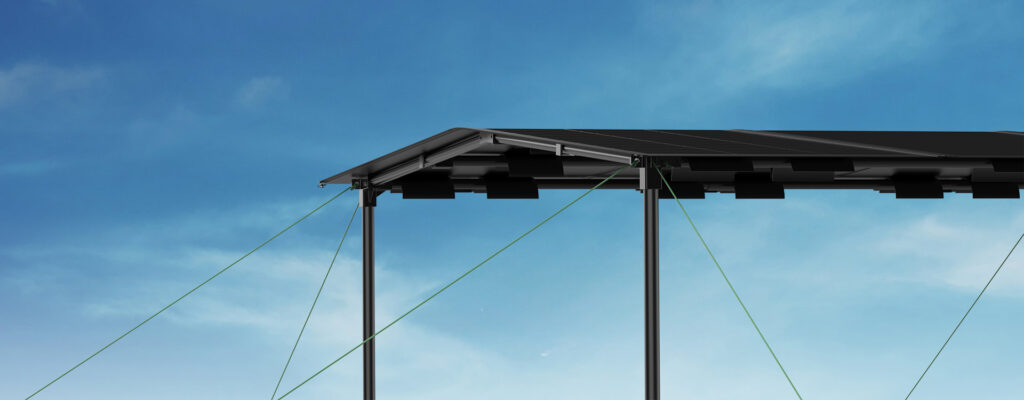
A Bifacial Photovoltaic Carport typically consists of a steel or aluminum superstructure elevated between 2.5 and 4 meters above the parking surface, giving vehicles clearance while also creating the open space needed for reflected light to reach the rear side of the panels. The canopy is fitted with purlins or rails that hold the bifacial modules at an optimal tilt, usually between 5 and 15 degrees for carport applications, balancing rainwater runoff with rear-side light capture. Underneath, the choice of paving material becomes a functional part of the energy system rather than a purely aesthetic decision, which is where the albedo effect comes into play later in this article.
Beyond the module and racking layer, a complete carport also includes a foundation system — typically driven steel piles, drilled piers, or ballasted concrete footings depending on soil conditions — combiner boxes, DC and AC wiring runs concealed within the structural columns, and often a central or string inverter bank located at the perimeter of the lot. Because the structure doubles as both a generation asset and a piece of parking infrastructure, drainage detailing, lighting integration, and column placement relative to parking stalls all have to be resolved jointly by the civil, structural, and electrical design teams rather than treated as separate disciplines.
How Bifacial Cells Differ at the Manufacturing Level
At the cell level, most bifacial modules today use passivated emitter and rear cell (PERC), tunnel oxide passivated contact (TOPCon), or heterojunction (HJT) architectures, all of which are inherently capable of absorbing light from either face once the rear metallization pattern is opened up rather than fully covered in aluminum, as is done in standard monofacial cells. This manufacturing shift does not require an entirely new production line in most cases, which is one reason bifacial modules have moved from a niche premium product to something close to the industry default within just a few years. For buyers evaluating a Bifacial Photovoltaic Carport quote, understanding which cell architecture underlies the proposed module helps clarify expected degradation rates, temperature performance, and long-term rear-side gain.
Why Bifacial Photovoltaic Carport Systems Generate More Power Than Traditional Panels
The central appeal of any Bifacial Photovoltaic Carport is straightforward: more electricity from the same footprint. Because parking lots are finite, valuable pieces of real estate, squeezing additional kilowatt-hours out of every module has an outsized impact on the overall economics of the project.
Front-Side and Rear-Side Energy Capture
In a standard installation, the front side of the module captures direct and diffuse sunlight exactly as a monofacial panel would. The rear side then adds a supplemental gain by capturing light that has reflected off the pavement, adjacent vehicles, and even nearby building facades. Because carports are elevated structures with open space underneath, they are uniquely well suited to this rear-side capture compared to ground-mounted arrays that sit close to the soil, where the modules themselves can block much of the reflected light.
Bifaciality Factor and Power Gain Percentages
Manufacturers rate bifacial modules using a “bifaciality factor,” which expresses the rear side’s power output as a percentage of the front side’s output under standard test conditions. Most commercial bifacial modules today have a bifaciality factor between 65% and 90%. In real-world carport deployments, where mounting height and reflective surfaces are favorable, total system energy gains of 8% to 20% over monofacial equivalents are common, with some elevated, high-albedo installations reporting gains above 25%. This power boost directly reduces the levelized cost of energy for the system, which is the single biggest driver of returns for any Bifacial Photovoltaic Carport project.
Elevated Mounting Height and Its Impact on Yield
Height matters enormously for bifacial performance. Because carports are naturally elevated to allow vehicle clearance, they already sit in the mounting-height “sweet spot” that ground-mount bifacial arrays often have to be specifically engineered to achieve. Studies of bifacial performance consistently show that rear-side gain increases with mounting height up to a point, since greater clearance allows light to reflect and diffuse more evenly across the entire rear surface of the module rather than concentrating unevenly near the panel edges. This is one of the key structural reasons that carports, as a category, are emerging as one of the best applications for bifacial technology.
Reduced Temperature Losses and Improved Performance Ratios
An often-overlooked benefit of the elevated, open-rack format used in carport applications is improved thermal performance. Solar cells lose efficiency as their operating temperature rises, and the free airflow beneath and around a Bifacial Photovoltaic Carport canopy helps keep module temperatures lower than they would be in a tightly packed rooftop or ground-mount array. Lower operating temperatures translate into a smaller gap between rated nameplate capacity and actual field performance, meaning the system’s real-world performance ratio — the metric engineers use to compare expected versus actual energy yield — tends to be higher for well-ventilated carport structures than for many other mounting configurations.
Diffuse Light Capture on Cloudy and Overcast Days
Because the rear side of a bifacial module responds to diffuse and scattered light rather than only direct beam radiation, a Bifacial Photovoltaic Carport tends to hold up relatively well on hazy, overcast, or partly cloudy days compared to a monofacial system, which relies almost entirely on front-side direct and diffuse irradiance. In regions with significant cloud cover for portions of the year, this characteristic can meaningfully smooth out the seasonal production curve, giving owners a more predictable and less weather-dependent energy output over the course of a full year.
The Albedo Effect: Maximizing Bifacial Photovoltaic Carport Performance Through Ground Reflectivity
If bifacial technology is the engine of extra energy production, albedo is the fuel that powers it. Albedo refers to the fraction of incoming solar radiation that a surface reflects rather than absorbs, expressed as a value between 0 (a surface that absorbs nearly all light, such as fresh asphalt) and 1 (a surface that reflects nearly all light, such as fresh snow). For any Bifacial Photovoltaic Carport, the albedo of the ground surface beneath and around the structure is one of the single most controllable variables affecting total energy output.
What Is Albedo and Why It Matters
Because the rear side of a bifacial panel depends entirely on reflected and diffuse light, the reflectivity of the surface below the array becomes a direct input into the system’s energy yield calculations. A dark, worn asphalt surface might have an albedo as low as 0.05 to 0.10, meaning it absorbs the vast majority of incident sunlight and reflects very little toward the panels above. A light-colored concrete surface, by contrast, can have an albedo of 0.25 to 0.40, effectively tripling or quadrupling the amount of light available for rear-side capture compared to dark asphalt.
Best Ground Surfaces Beneath a Bifacial Photovoltaic Carport
Given this relationship, developers planning a Bifacial Photovoltaic Carport increasingly specify high-albedo paving materials during the design phase rather than treating the parking surface as an afterthought. Light gray or white concrete, reflective coatings applied to existing asphalt, and light-colored gravel or crushed stone are all common choices. Some large commercial projects even apply specialized white or light-tinted acrylic coatings specifically engineered to boost albedo without compromising the pavement’s durability or slip resistance, since a modest paving-related investment can generate measurable extra kilowatt-hours for the entire operating life of the system.
Seasonal and Weather Variations in Albedo
Albedo is not a fixed number; it fluctuates with weather, moisture, and even the season. Wet pavement generally reflects less light than dry pavement, temporarily reducing rear-side gain during rainy periods. Conversely, in regions that receive snow, ground albedo can spike dramatically during winter months, sometimes offsetting the lower sun angle and shorter days with a substantial rear-side production boost. Understanding these seasonal swings allows asset owners and engineers to more accurately forecast the annual energy profile of a Bifacial Photovoltaic Carport and to set realistic expectations with stakeholders and financiers.
Modeling Albedo in Energy Yield Software
Modern solar design and simulation platforms allow engineers to input a site-specific ground albedo value, along with module height, tilt, and row spacing, to generate a much more accurate bifacial energy yield projection than a simple flat percentage adder. For a large commercial Bifacial Photovoltaic Carport, running this kind of detailed simulation during the feasibility stage is important, since even a difference of 0.05 to 0.10 in assumed ground albedo can shift projected annual energy output by several percentage points, which in turn affects financing assumptions and the overall investment case presented to lenders or ownership.
Combining Albedo Optimization With Landscaping and Site Planning
Because ground albedo can be influenced through site planning decisions beyond just paving color, some developers also consider the reflectivity of adjacent building facades, retaining walls, or hardscape features when laying out a Bifacial Photovoltaic Carport. Light-colored perimeter walls or curbing, for example, can contribute marginally to the reflected light pool available to modules positioned near the edge of an array. While these secondary reflective surfaces typically contribute far less than the primary ground surface directly beneath the canopy, they illustrate how albedo optimization can be treated as a holistic site design exercise rather than a single paving material decision made in isolation.
Financial Analysis: Calculating ROI for a Bifacial Photovoltaic Carport Investment
Ultimately, the technical advantages of bifacial technology and albedo optimization matter because they translate into better financial performance. Property owners, fleet operators, and commercial developers evaluate solar carports the same way they evaluate any capital project: through payback period, internal rate of return, and total lifetime savings.
Capital Costs vs. Long-Term Energy Savings
A Bifacial Photovoltaic Carport typically costs somewhat more upfront than a comparable monofacial installation, largely due to the premium associated with dual-glass modules and, in some cases, additional structural reinforcement to accommodate the panel’s slightly heavier weight. However, because the incremental cost per watt of bifacial modules has fallen sharply as manufacturing scale has increased, the price premium today is often in the range of 3% to 8% over monofacial equivalents, while the corresponding energy gain can be two to three times that percentage. This asymmetry between marginal cost and marginal energy output is the foundation of the improved ROI that a Bifacial Photovoltaic Carport can deliver.
Payback Period Comparisons: Bifacial vs. Monofacial Carports
When modeled over a typical 25-year system lifetime, the higher energy yield of bifacial modules commonly shortens the simple payback period by one to three years compared to a monofacial carport of the same footprint, depending on local electricity rates, incentive structures, and ground albedo conditions. For commercial and industrial property owners paying high daytime electricity rates, this accelerated payback can be even more pronounced, since the additional bifacial energy is generated throughout the day and directly offsets peak-rate consumption.
Additional Revenue Streams: EV Charging and Net Metering
Many Bifacial Photovoltaic Carport projects are now paired with on-site electric vehicle charging infrastructure, creating a second revenue stream layered on top of the energy savings from self-consumption. Because the carport already elevates panels above the parking surface, integrating EV chargers into the support columns is a natural architectural fit. In regions with net metering or feed-in tariff programs, any surplus bifacial energy generated beyond on-site demand can be exported to the grid for credit, further strengthening the overall return profile of the installation.
Depreciation, Tax Incentives, and Financing Structures
In many markets, commercial solar assets — including carport structures — qualify for accelerated depreciation schedules and investment tax credits or similar incentive programs, which can meaningfully improve after-tax returns for the system owner. Because a Bifacial Photovoltaic Carport typically qualifies for the same incentive treatment as any other commercial solar installation despite its higher energy output, the effective return on the incremental bifacial investment is often better than a simple comparison of module price would suggest. Third-party ownership structures such as power purchase agreements and operating leases also allow property owners to benefit from bifacial energy gains without carrying the asset on their own balance sheet, shifting both the upfront capital requirement and the long-term performance risk to a specialized solar developer or financier.
Long-Term Degradation and Warranty Considerations
ROI calculations should also account for module degradation over the system’s operating life. Premium bifacial glass-glass modules frequently carry linear performance warranties guaranteeing 87% or more of rated output after 25 to 30 years, often with a lower first-year degradation rate than older monofacial products. Because degradation directly affects the energy production side of the ROI equation for a Bifacial Photovoltaic Carport, comparing warranty terms across module suppliers is just as important as comparing sticker price when evaluating competing project bids.
Design and Engineering Considerations for Bifacial Photovoltaic Carport Installations
Realizing the full performance and financial benefits of a Bifacial Photovoltaic Carport requires careful attention to structural, electrical, and site-specific design choices well before construction begins.
Structural Load and Racking Requirements
Because bifacial glass-glass modules are typically 1 to 3 kilograms heavier per unit than monofacial panels with polymer backsheets, structural engineers must account for this additional dead load, along with wind and snow loads, when sizing the steel columns, beams, and foundations of the carport. Open racking designs that minimize shading of the rear panel surface — such as slim purlins and unobstructed mounting rails — are strongly preferred over racking systems that were originally designed for monofacial applications, since any rear-side obstruction directly reduces the bifacial gain the structure is meant to capture.
Row Spacing, Tilt Angle, and Orientation
For multi-row Bifacial Photovoltaic Carport layouts, row spacing and orientation take on added importance compared to monofacial design. Adequate spacing between rows prevents adjacent structures from shading the ground area that feeds rear-side reflection, while tilt angle is often optimized slightly differently than it would be for a monofacial system, balancing front-side irradiance capture against the amount of open ground exposed to the sky beneath and around the array. South-facing orientation (in the northern hemisphere) generally remains optimal, though bifacial systems tend to be somewhat more forgiving of orientation deviations because rear-side gain partially compensates for suboptimal front-side angles.
Selecting the Right Bifacial Modules
Not all bifacial modules are created equal. Buyers evaluating panels for a Bifacial Photovoltaic Carport project should compare bifaciality factors, front and rear power temperature coefficients, frame design (frameless modules generally allow slightly more light to reach the rear cell edges), and manufacturer warranties, which increasingly extend to 25 or even 30 years for premium glass-glass products. Working with an experienced solar engineering, procurement, and construction (EPC) partner who has specific carport and bifacial project experience helps ensure that module selection, racking design, and albedo optimization are treated as an integrated system rather than as separate decisions.
Electrical Design and Inverter Sizing
Because bifacial modules can produce meaningfully more current than their nameplate front-side rating suggests, especially under high-albedo, high-irradiance conditions, electrical designers need to size string configurations, combiner boxes, and inverters with adequate headroom to avoid clipping losses. Central inverters and string inverters both work well in carport applications, though the choice often comes down to site size, maintenance preferences, and whether module-level monitoring is desired to track front- and rear-side performance separately. Proper electrical design ensures that the additional energy a Bifacial Photovoltaic Carport generates on bright, high-reflectivity days is actually captured and delivered rather than lost to inverter saturation.
Drainage, Snow Load, and Regional Climate Adaptations
Carport canopies also have to be engineered for the specific climate of their installation site. In snow-prone regions, tilt angle and structural load calculations must account for accumulated snow weight, while in high-wind coastal areas, uplift forces on the elevated canopy become a governing structural design factor. Drainage channels integrated into the carport’s purlins or gutters are also important, both to protect parked vehicles from runoff and to prevent water pooling on the ground surface beneath the array, which would otherwise temporarily reduce local albedo and rear-side energy capture immediately following rainfall.
Real-World Applications and Case Studies of Bifacial Photovoltaic Carport Projects
The theoretical advantages of bifacial technology and albedo optimization are increasingly backed by real-world deployments across commercial, retail, and institutional settings.
Commercial Parking Lots and Corporate Campuses
Corporate campuses with large surface parking lots represent one of the most natural fits for a Bifacial Photovoltaic Carport. These sites typically have significant unshaded parking area, consistent daytime electricity demand that aligns well with solar generation, and a strong incentive to reduce operating costs while also providing employees with shaded, weather-protected parking as an added amenity. Several large technology and logistics companies have publicly highlighted carport solar installations as part of their broader sustainability and net-zero commitments, often citing both the energy output and the covered-parking benefit as justification for the investment.
Retail Centers and Public Facilities
Shopping centers, hospitals, universities, and municipal facilities are increasingly adopting Bifacial Photovoltaic Carport structures over their parking areas. These installations combine visible sustainability branding with tangible operating cost reduction, and the elevated canopy structure also improves the customer or visitor experience by shielding vehicles from sun and precipitation. Because these facilities often have flat, light-colored asphalt or concrete lots already in place, they frequently require only modest surface treatment to substantially boost ground albedo and rear-side energy capture.
EV Charging Hubs
Dedicated EV charging hub operators have also embraced the Bifacial Photovoltaic Carport format, since it allows a single structure to generate power, provide weather protection, and support charging infrastructure in one integrated footprint. The additional bifacial energy yield is particularly valuable in this application because it can reduce reliance on grid electricity purchases during peak charging demand periods, directly improving the unit economics of the charging business.
Airports, Transit Hubs, and Fleet Depots
Airports and public transit park-and-ride facilities are also well suited to large-scale carport solar because they typically have vast, unshaded surface parking areas with light-colored concrete or newly resurfaced asphalt already in place. Municipal and regional transit authorities that have deployed carport solar frequently cite both the direct energy cost savings and the improved passenger experience from covered, weather-protected parking as justification for the investment. Similarly, logistics and delivery fleet depots, which often maintain large paved yards for vehicle staging, are beginning to adopt the Bifacial Photovoltaic Carport model both to generate power for fleet electrification and to extend vehicle life by reducing sun exposure and heat buildup in parked vehicles.
Overcoming Challenges: Common Obstacles in Bifacial Photovoltaic Carport Deployment
Despite the clear advantages, project developers should go into a Bifacial Photovoltaic Carport project with realistic awareness of the practical challenges involved.
Higher Upfront Costs and Financing
The modest cost premium associated with bifacial modules and reinforced carport structures can still be a hurdle for budget-constrained projects, particularly for smaller property owners without access to favorable commercial solar financing. Power purchase agreements, solar leases, and various tax incentive structures, where available, can help bridge this upfront cost gap, allowing owners to benefit from the improved long-term returns of bifacial technology without bearing the full capital cost themselves.
Shading and Soiling Concerns
Because bifacial gain depends on unobstructed light reaching both sides of the panel, any structural component, dust accumulation, or debris that shades the rear surface directly erodes performance. Regular maintenance and cleaning schedules, along with careful electrical and structural design that avoids unnecessary rear-side obstructions, are essential to preserving the full energy benefit of a Bifacial Photovoltaic Carport over its operating lifetime.
Permitting and Local Regulations
Elevated parking structures often trigger additional building code, fire access, and structural permitting requirements compared to simple rooftop solar installations. Local jurisdictions may also have specific rules regarding parking lot coverage, stormwater management, and setback distances that affect the design and layout of a Bifacial Photovoltaic Carport. Engaging early with local permitting authorities and experienced local contractors helps avoid costly redesigns or delays later in the project timeline.
Interconnection Timelines and Grid Capacity
In many markets, utility interconnection queues have grown significantly longer as commercial and industrial solar deployment has accelerated, and a large Bifacial Photovoltaic Carport project is no exception to this trend. Developers should budget realistic timelines for utility interconnection studies, transformer upgrades, and metering changes, particularly for projects that plan to export surplus energy or that are sized to serve a significant share of a facility’s total electricity demand. Early engagement with the local utility, ideally in parallel with structural design and permitting, helps prevent interconnection delays from becoming the critical path item that pushes back a project’s overall completion date and delays the start of ROI-generating energy production.
The Future of Bifacial Photovoltaic Carport Technology in Solar Energy Markets
As module costs continue to decline and bifacial manufacturing becomes the industry default rather than a premium option, the economic case for the Bifacial Photovoltaic Carport format is likely to strengthen further in the years ahead.
Emerging Materials and Efficiency Gains
Ongoing advances in cell architecture, including higher-efficiency TOPCon and heterojunction bifacial cells, continue to push both front- and rear-side conversion efficiency higher. As these next-generation cell technologies become standard across the industry, the baseline bifaciality factor of commercially available modules is expected to rise, further widening the performance gap between bifacial and monofacial carport installations.
Integration with Smart Grids and Storage
Looking forward, Bifacial Photovoltaic Carport installations are increasingly being paired with on-site battery storage and smart energy management systems, allowing property owners to store surplus midday generation for use during evening peak demand or to support EV charging loads after daylight hours. This integration transforms the carport from a simple generation asset into a flexible, dispatchable component of a broader on-site energy ecosystem, further enhancing the long-term value proposition of the technology.
Bringing all of these threads together, the case for the Bifacial Photovoltaic Carport rests on a simple but powerful combination: elevated structures that are naturally suited to rear-side light capture, ground surfaces that can be optimized for albedo with modest additional investment, and module technology that keeps improving in efficiency and cost. For property owners weighing solar options over parking areas, a well-designed Bifacial Photovoltaic Carport offers a compelling path to higher energy yield, faster payback, and stronger long-term return on investment than conventional monofacial alternatives.